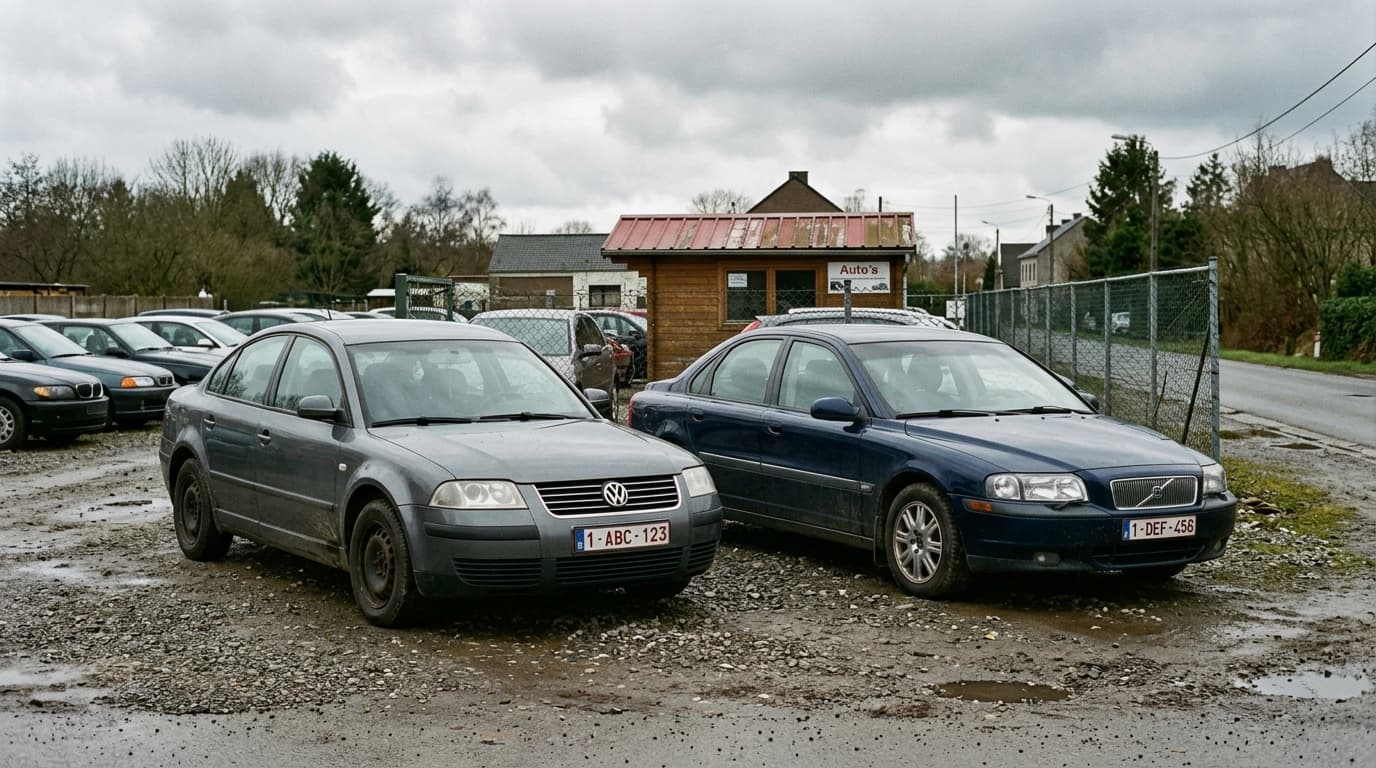
In a classified ad, a used Lexus ES 300h and a used Mercedes E-Class look alike: two saloons close to five metres long, an automatic gearbox, a similar price. On a Walloon tax bill, the Mercedes E 220 d costs €432.30 a year and the Lexus €818.14. The Lexus takes the lead elsewhere, on how long its maker still agrees to cover it.
Used Lexus ES 300h or Mercedes E-Class: which one costs less to keep?
On tax, the diesel Mercedes. On warranty cover, the Lexus. The rest, servicing and depreciation, cannot be costed in Belgium from a public source, and I say so instead of estimating it.
The Lexus ES 300h pairs a 2,487 cc four-cylinder petrol engine with an electric motor, for a combined 160 kW. The facelifted W213 Mercedes E 220 d runs a 1,950 cc diesel with 143 kW. The petrol E 200 of the same generation has 1,991 cc and 135 kW. Three engine sizes, three tax bands.
A note for readers new to Belgium: annual road tax (taxe de circulation) is set by fiscal horsepower, itself derived from engine capacity, and the registration tax (TMC, taxe de mise en circulation) is paid once each time a car is registered in a new owner's name. Both are regional.
| Item, car registered in Wallonia | Lexus ES 300h | Mercedes E 220 d | Mercedes E 200 |
|---|---|---|---|
| Engine capacity | 2,487 cc | 1,950 cc | 1,991 cc |
| Power | 160 kW | 143 kW | 135 kW |
| Fiscal horsepower | 13 CV | 10 CV | 11 CV |
| Annual road tax | €818.14 | €432.30 | €561.00 |
| Road tax over three years | €2,454.42 | €1,296.90 | €1,683.00 |
| Registration tax base amount | €5,159.25 | €2,579.10 | €2,579.10 |
| Manufacturer cover available up to | 10 years or 185,000 km | not verified | not verified |
The E 220 d stops at 1,950 cc, the very last cubic centimetre of the 10 fiscal horsepower band. That is no accident of engineering, and it saves €128.70 a year against the E 200.
How much is the annual road tax on each, region by region?
In Wallonia, €818.14 a year for the Lexus and €432.30 for the E 220 d, on the SPW Finances scale valid from 1 July 2026 to 30 June 2027, surcharges included. The gap is €385.84 a year, or €1,157.52 over three years of ownership, before the indexation applied each 1 July.
Flanders starts from the same fiscal horsepower and then adjusts it. The base amounts published by the Flemish Region for the same period are €743.76 at 13 fiscal horsepower, €510.12 at 11 and €393.00 at 10. A CO₂ correction applies on top, 0.30% per gram above or below 149 g/km WLTP for cars first registered from 2021, followed by a correction for Euro standard and fuel. The Lexus hybrid, at around 120 g, claws back part of its engine-size handicap there. Part of it only: before correction, €350.76 separate the two cars.
Brussels uses its own scale by fiscal horsepower, reindexed on 1 July 2026. The Region points to MyTax for the detail and I could not record the 2026-2027 amounts per band. I therefore publish no Brussels figure.
Why does the Lexus pay more at registration in Wallonia?
For five kilowatts.
Since 1 July 2025, the Walloon registration tax multiplies a base amount tied to power by the ratio of CO₂ to 136 in WLTP, by the ratio of gross vehicle weight to 1,838 kg, then by an energy coefficient: 1 for a combustion engine, 0.8 for a hybrid. The base amount is €2,579.10 between 121 and 155 kW. Above 155 kW it becomes €5,159.25. The Lexus makes 160 kW.
Run the numbers with an age coefficient of 100%. For the ES 300h, 120 g of CO₂ and a gross vehicle weight of 2,150 kg: 5,159.25 × 120/136 × 2,150/1,838 × 0.8, which gives €4,260.02. For the E 220 d, 2,410 kg and CO₂ ranging from 136 to 163 g depending on equipment: from €3,381.74 to €4,053.11. The diesel, at 1,750 kg unladen, heavier and higher in emissions, pays less than the hybrid. The gap runs from €206.91 to €878.28.
That amount is then multiplied by an age coefficient, identical for both cars of the same year: 90% at one year, 80% at two years, and the scale goes down to 30% at ten years. At two years old, the Lexus therefore pays €3,408.02 and the leanest Mercedes €2,705.39. The gap narrows with age and never reverses: an ES would need 95 g of CO₂ to match the leanest E 220 d, and the Lexus specification sheet starts at 119.54 g.
At 155 kW, the Walloon base amount is €2,579.10. At 156 kW, it is €5,159.25. The Lexus makes 160.
The old Walloon eco-malus disappeared with that reform: CO₂ now sits inside the formula, not in a separate tax.
Which one is more reliable past six years?
For the Mercedes, the answer comes with numbers. For the Lexus, it does not.
The TÜV Report 2026, built on German roadworthiness tests, tracks the E-Class across six age bands. It beats the average while young, then crosses to the other side.
| Vehicle age | E-Class, major defects | Average, all models |
|---|---|---|
| 2-3 years | 4.9% | 6.4% |
| 4-5 years | 7.5% | 9.1% |
| 6-7 years | 13.2% | 13.6% |
| 8-9 years | 18.1% | 17.9% |
| 10-11 years | 25.3% | 23.0% |
| 12-13 years | 28.6% | 28.1% |
The detail published by AutoBild on 13 May 2026 names the weak points. On the W213, built since 2016:
- NOx sensors that fail on diesels;
- infotainment faults;
- coolant loss;
- axle suspension, where the defect rate climbs after six years.
On the W212 before it, the OM651 diesel combines particulate filter, injector and timing chain trouble. Lighting and braking hold up well across all generations.
The Lexus ES appears nowhere in the report. Too few are registered in Germany. I have seen too many articles fill that gap with American rankings covering other versions; missing data stays missing data. It proves nothing either way.
Until what age does the manufacturer still cover the car?
Ten years at Lexus, and it is the only reliability argument I can verify on the ES.
Lexus Relax adds 12 months or 15,000 km of warranty at every service carried out by an official repairer, until the car is 10 years old or has covered 185,000 km. The programme also applies to a Lexus bought used, and earlier servicing outside the network does not close the door. The trade-off is mechanical: over 100,000 km, that means six visits to the network, at network prices. Lexus does not publish those prices for Belgium. Have the dealer quote the six services before you sign, and compare the total with what the warranty covers.
On the Mercedes side, I could not verify on 4 October 2026 the Belgian warranty terms for a used E-Class sold by the network: duration, maximum age, mileage cap. I am not making them up. Demand them in writing, with the list of exclusions. On a seven-year-old W213, the axle suspension mentioned above is exactly the kind of part a used-car contract files under wear.
An E-Class owner still under factory warranty also keeps the right to have the car serviced outside the network without losing that warranty. With Relax that right is of no use: servicing inside the network is what recharges the cover.
How much value does each lose after four or five years?
No public, dated Belgian series measures it. The only named comparison comes from the United States: over five years, iSeeCars records 45.2% of value lost for the Lexus ES 300h and 59.2% for the Mercedes E-Class, figures consulted on 4 October 2026. Fourteen points apart, on a market where the Lexus sells in volume, which is not the case here.
I do not convert those percentages into Belgian euros. The only local marker I can date is the new price: in January 2023, the ES 300h range ran from €55,700 to €72,800 in Belgium, from the base version to the Privilege Line. Rarity on the Belgian market cuts both ways at resale: little supply, but also few buyers looking for this model. Luxury car depreciation explains the mechanism.
The verdict, item by item
Over three years in Wallonia, the Mercedes E 220 d starts €1,157.52 ahead on annual road tax and €206.91 to €878.28 ahead on registration tax before the age coefficient. That lead is firm and can be calculated before the viewing.
The Lexus ES 300h answers with a warranty that recharges up to ten years and slower depreciation on the only public data set there is. Both advantages count if you keep the car a long time and accept network prices at every service.
For 20,000 km a year on the motorway and a resale after three years, I would take the Mercedes. For a car kept until 185,000 km, the Lexus. In between, the quote for the six services decides.
If this is a first purchase in the segment, the best used luxury cars for a first purchase compare the warranties of three manufacturer programmes. Before looking at an ad from Germany, read the traps of the Belgian market. Models costed item by item are in the luxury car ranking.
Sources
- SPW Finances, annual road tax amounts, surcharges included, valid from 1 July 2026 to 30 June 2027, consulted on 4 October 2026: €432.30 at 10 CV (1,751 to 1,950 cc), €561.00 at 11 CV (1,951 to 2,150 cc), €818.14 at 13 CV (2,351 to 2,550 cc).
- Flemish Region, annual road tax rates for cars, valid from 1 July 2026 to 30 June 2027, consulted on 4 October 2026: €393.00 at 10 CV, €510.12 at 11 CV, €743.76 at 13 CV before corrections, CO₂ correction of 0.30% per gram around 149 g/km WLTP for first registrations from 2021.
- Brussels-Capital Region, new rates for Brussels road taxes, consulted on 4 October 2026: new rates on 1 July 2026, detail referred to MyTax, amounts per band not recorded.
- SPW Finances, leaflet on the registration tax reform, consulted on 4 October 2026: formula, references of 136 g WLTP and 1,838 kg, 0.8 coefficient for a hybrid, age scale from 90% to 30% between one and ten years, €9,000 cap.
- Moniteur Automobile, registration tax, updated on 1 July 2026, consulted on 4 October 2026: base amounts of €2,579.10 from 121 to 155 kW and €5,159.25 above 155 kW, coefficients of 90% at one year and 80% at two years.
- Lexus Europe, Lexus Relax warranty, consulted on 4 October 2026: 12 months or 15,000 km at every service inside the network, up to 10 years or 185,000 km, applicable to used vehicles, with no condition on earlier service history.
- Lexus, ES 300h specification sheet, consulted on 4 October 2026: 2,487 cc, 160 kW, CO₂ from 119.54 g/km WLTP.
- Autotijd, Lexus ES 300h 2018-2021 specifications and Mercedes E 220 d saloon 2020-2023 specifications, consulted on 4 October 2026: gross vehicle weight of 2,150 kg for the Lexus; 1,950 cc, 143 kW, 136 to 163 g/km WLTP, 1,750 kg unladen and 2,410 kg gross vehicle weight for the Mercedes. Belgian prices for the Lexus ES recorded on the same site, January 2023 price list: from €55,700 to €72,800.
- Ultimate Specs, Mercedes E 200 W213 (2016-2019) specifications, consulted on 4 October 2026: 1,991 cc, 135 kW.
- AutoBild, Mercedes E-Class in the TÜV Report 2026, article dated 13 May 2026, consulted on 4 October 2026: major defect rates by age band and weak points of the W212 and W213 generations.
- iSeeCars, Lexus ES 300h and Mercedes E-Class comparison, consulted on 4 October 2026, US market: 45.2% of value lost over five years for the ES 300h, 59.2% for the E-Class.
Comparator
Compare voitures de luxe side by side.
Compare now →
Frequently asked questions
Renaud a passé neuf ans comme gestionnaire de parc chez un loueur longue durée belge, du côté où l'on calcule la valeur résiduelle d'une berline allemande à 48 mois avant même de la commander. Il a quitté le métier en 2020 et écrit depuis sur le haut de gamme, depuis Namur.