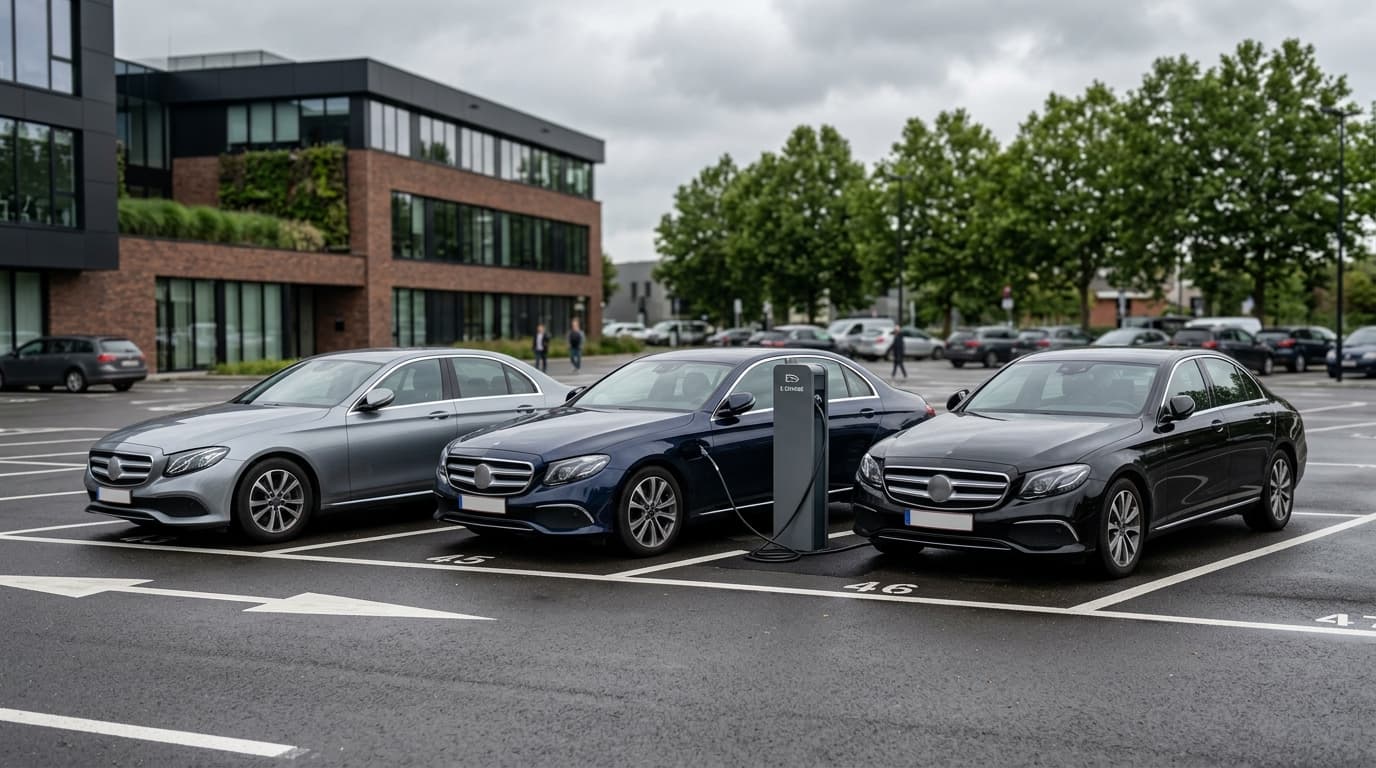
For a company ordering new in 2026, the question "petrol or diesel" no longer decides anything: both are 0% deductible. The only arbitrage left is combustion against electric, and it runs to several thousand euros a year.
Does petrol versus diesel still mean anything in 2026?
For a new company order, no. Both engine types have been 0% deductible since 1 January 2026. Depreciation, servicing, fuel, insurance: none of it goes through as a professional expense any more.
This is not a tweak to a scale, it is the end of a category. The timetable set by the Law of 25 November 2021 on the green reform of mobility taxation extinguished the deduction for combustion engines on every order signed from 1 January 2026. Diesel long held a tax advantage over petrol on company cars — better deductibility, lower benefit in kind, smaller contribution. That advantage is gone, because the term of comparison is gone.
The question stays alive in two cases only. First: you are choosing between two vehicles already ordered under the transitional regime, between 1 July 2023 and 31 December 2025. Second: you are buying in your own name, outside the company, and you want to know which of the two costs less to run. I have put figures on both below.
What is the difference between a company car and a job car?
None, under Belgian tax law. Both expressions describe the same thing: a vehicle made available by the employer or the company, usable privately by its driver.
Everyday use draws a distinction the tax authority does not. "Job car" suggests the employee whose car is part of the salary package; "company car" suggests the director who puts it on the balance sheet of their own structure. The Income Tax Code knows one criterion only: making the car available for private use. As soon as that exists, the benefit in kind is due and so is the solidarity contribution, whichever word the car policy uses.
What actually changes is the driver's status, not the vehicle's name. An employee who opts for the flat-rate deduction of professional expenses gets a €500 annual exemption on the benefit in kind for home-to-work travel. A company director is not entitled to it. The detail of the calculation is in my article on how the benefit in kind is calculated.
Why does a diesel pay more than a petrol at equal emissions?
Because both Belgian scales work against it, measurably so. The ONSS contribution formula subtracts €600 for diesel against €768 for petrol, and the 2026 reference emission for the benefit in kind is 58 g/km for diesel against 70 g/km for petrol.
Both scales assume a diesel naturally emits less CO2 than a petrol of comparable output. They correct the gap upstream. The result is that, at strictly identical emissions, diesel is penalised twice.
I worked out both switchover thresholds, because nobody publishes them:
| Scale | Emissions gap needed for diesel to match petrol |
|---|---|
| Benefit in kind (58 g reference against 70 g) | 12.0 g/km lower |
| CO2 contribution (€600 against €768) | 18.7 g/km lower |
Put another way: a diesel emitting 15 g/km less than the equivalent petrol wins on the benefit in kind and still loses on the ONSS contribution. Below a 12 g/km gap, it loses on both. At 140 g/km for both engine types, the contribution costs €3,206.11 a year on petrol and €4,300.88 on diesel, a €1,094.77 annual gap — for a car emitting exactly the same amount.
A diesel has to emit 18.7 g/km less than the petrol merely to match it on the ONSS contribution. Below that, it pays more for the same quantity of CO2.
What is the net cost gap between a diesel and a premium electric?
On the lines I can put figures on without inventing anything, the annual gap reaches €3,206.31 in ONSS contribution and €4,583.76 in benefit in kind, before deductibility even enters the picture. The table below compares three engine types on a list value of €61,468, that of the entry-level Mercedes-Benz E-Class taken on 1 August 2026.
| Item, 2026 | Petrol 150 g/km | Diesel 130 g/km | Electric |
|---|---|---|---|
| Deductibility, 2026 order | 0% | 0% | 100% |
| ONSS CO2 contribution, monthly | €316.05 | €309.53 | €42.34 |
| ONSS CO2 contribution, annual | €3,792.59 | €3,714.39 | €508.08 |
| Applicable benefit-in-kind rate | 13.5% | 12.7% | 4.0% |
| Annual benefit on €61,468 | €7,112.73 | €6,691.23 | €2,107.47 |
| Walloon road tax | by fiscal hp | by fiscal hp | €107.18 |
The 150 and 130 g/km figures are calculation assumptions, not readings: I found no dated, verifiable WLTP value per version as at 18 August 2026, and I do not publish a figure I could not source. The formulas, on the other hand, are the statutory ones, and the result can be recomputed in three lines.
On top of those amounts sits the cost of non-deductibility, which depends on the annual budget of the vehicle. The arithmetic is simple: for every €10,000 of non-deductible annual costs, a company pays €2,500 more tax at the full 25% rate, or €2,000 at the 20% SME rate on its first €100,000 of taxable base. On a premium running €20,000 of annual costs, the combustion car therefore costs €5,000 more tax a year than the electric one, at identical budget.
What happens to a plug-in hybrid ordered after 1 January 2026?
For a company, it drops to 0% deductibility, exactly like a petrol or a diesel. The plug-in hybrid is no longer a tax compromise: the timetable treats it as a combustion car.
One exception survives, and it is narrow. A self-employed person taxed as an individual — not a company — keeps the right to deduct the costs of a plug-in hybrid until 31 December 2026, provided the vehicle emits at most 50 g of CO2 per kilometre. From 1 January 2027 that tolerance disappears and the self-employed individual is treated like a company: 0% on any new combustion order.
For plug-in hybrids ordered since 1 January 2023 and still under the earlier regime, a specific rule caps the deduction of fossil fuel costs at 50%, while electricity follows the vehicle's overall regime. The logic is explicit: the scale pushes you to plug the car in rather than fill it up.
How much is the CO2 contribution by engine type in 2026?
Between €508.08 and more than €6,000 a year, for the same person and the same use. The solidarity contribution paid to the ONSS is monthly, calculated on emissions, and multiplied by a factor that rises every year for any order signed since 1 July 2023.
The base formula has not changed: [ ( CO2 emissions × €9 ) − 768 (petrol) or 600 (diesel) ] / 12. The result is indexed by the ratio 185.85 / 114.08 for 2026, then multiplied by 4. That factor was 2.25 in 2023, it is 4 in 2026 and it moves to 5.5 in 2027.
| Emissions | Petrol, annual | Diesel, annual |
|---|---|---|
| 100 g/km | €860.18 | €1,954.94 |
| 120 g/km | €2,033.14 | €3,127.91 |
| 140 g/km | €3,206.11 | €4,300.88 |
| 160 g/km | €4,379.07 | €5,473.84 |
| 180 g/km | €5,552.04 | €6,646.81 |
An electric car does not escape this contribution: it pays the floor, €42.34 a month in 2026. That amount comes from the non-indexed floor of €25.99 set for 2026, indexed by the same ratio. It rises to €28.57 non-indexed in 2027 and €31.15 in 2028, so the gap with a combustion car narrows from below — very slowly.
The multiplication factor does not apply to vehicles ordered before 1 July 2023. For those, the floor stays at €33.93 a month in 2026 and the formula is only indexed, never multiplied. That is the main residual advantage of older fleets.
What the region of registration adds to the bill
In Wallonia, the annual road tax on an electric car is €107.18, against €561.00 for a vehicle of 11 fiscal horsepower and €1,075.54 for 15 hp. SPW Finances scale valid from 1 July 2026 to 30 June 2027, indexed every 1 July.
| Engine capacity | Fiscal horsepower | Walloon road tax |
|---|---|---|
| 1,951 – 2,150 cc | 11 hp | €561.00 |
| 2,151 – 2,350 cc | 12 hp | €689.70 |
| 2,551 – 2,750 cc | 14 hp | €946.84 |
| 2,751 – 3,050 cc | 15 hp | €1,075.54 |
| Electric | treated as 4 hp and under | €107.18 |
An electric car is taxed in Wallonia on the flat basis of 4 fiscal horsepower and under, whatever its real output. A 3.0-litre V6 diesel therefore pays ten times more than a 400 hp electric. The Walloon registration tax, by contrast, depends on power, CO2, maximum authorised mass and energy, with a floor of €50 and a cap of €9,000 after reduction.
Brussels and Flanders apply their own grids, and Flanders ended on 1 January 2026 the full exemption electric cars used to enjoy. I could not verify the 2026 Flemish and Brussels amounts against an official source as at 18 August 2026, so I do not publish them here: each administration's regional calculator remains the only reliable reference on that point.
When does a combustion car still make sense?
When it sits outside the company. A combustion car bought in your own name is subject to neither the 0% deductibility, nor the ONSS contribution, nor the benefit in kind — the three lines that make up most of the gap calculated above.
Three situations hold up in 2026. A high-mileage rural driver with no way to charge at home, for whom the Belgian public network stays a cost and a time item. A driver who tows regularly, where an electric car's range falls heavily. And buying a used premium in your own name, where the depreciation already absorbed by the first owner weighs more than any tax line — the subject of my article on the traps of the Belgian used market.
For everything else, the calculation has leaned the same way since 1 January 2026, and the detail of the deductibility timetable is in what the end of deductibility changes. The concrete models, with the Tesla Model 3 from €35,990, the BMW i5 at €74,100 and the Volvo EX90 at €84,490, are compared line by line in premium company cars for a self-employed person and taken up with their regional taxes in the luxury car ranking. The full reasoning, item by item, is in the company car guide.
One last point that bothers me, and that no scale settles: Moniteur Automobile shows €177.11 of monthly benefit in kind for the Tesla Model 3 Premium Long Range All-Wheel Drive at €49,990 as at 18 August 2026, where the statutory formula applied to that list value gives €142.83. I do not know what the simulator adds. I publish the statutory calculation, I flag the gap, and I would rather you redid the sum on your own order form than copied a simulator.
Sources
- Securex, calculation of the ONSS solidarity contribution, updated 21 May 2026, consulted 18 August 2026: formula [ (CO2 × 9) − 768 or 600 ] / 12, indexation coefficient 185.85 / 114.08, factors 2.25 / 2.75 / 4.00 / 5.50, non-indexed floors of €23.41 / €25.99 / €28.57 / €31.15 and the €33.93 floor for orders before 1 July 2023.
- Moniteur Automobile, "Tax deductibility: the 2026 rules", published 1 April 2026 by Olivier Duquesne, consulted 18 August 2026: 0% deductibility for combustion cars ordered in 2026, 100% for electric, the plug-in hybrid exception for self-employed individuals until 31 December 2026, transitional caps of 50% in 2026 and 25% in 2027, VAT at 50% maximum.
- SPW Finances, taxation of electric cars in Wallonia, page updated 30 June 2026, consulted 18 August 2026: road tax of €107.18, registration tax floor of €50 and cap of €9,000.
- SPW Finances, road tax scale, additional percentages included, valid 1 July 2026 to 30 June 2027, consulted 18 August 2026: amounts by fiscal horsepower band.
- Law of 25 November 2021 on the green fiscal and social reform of mobility, Belgian Official Gazette: deductibility phase-out timetable and multiplication of the CO2 contribution.
- Royal Decree of 17 December 2025, Belgian Official Gazette of 24 December 2025: 2026 reference emissions of 70 g/km for petrol and 58 g/km for diesel.
- Moniteur Automobile, Tesla Model 3 2026 prices, taken 18 August 2026: from €35,990 to €57,490, and €49,990 for the Premium Long Range All-Wheel Drive. Prices for the BMW i5 (€74,100), the Volvo EX90 (€84,490) and the Mercedes-Benz E-Class (€61,468) taken on the same site on 1 August 2026.
Comparator
Compare voitures de luxe side by side.
Compare now →
Frequently asked questions
Renaud a passé neuf ans comme gestionnaire de parc chez un loueur longue durée belge, du côté où l'on calcule la valeur résiduelle d'une berline allemande à 48 mois avant même de la commander. Il a quitté le métier en 2020 et écrit depuis sur le haut de gamme, depuis Namur.