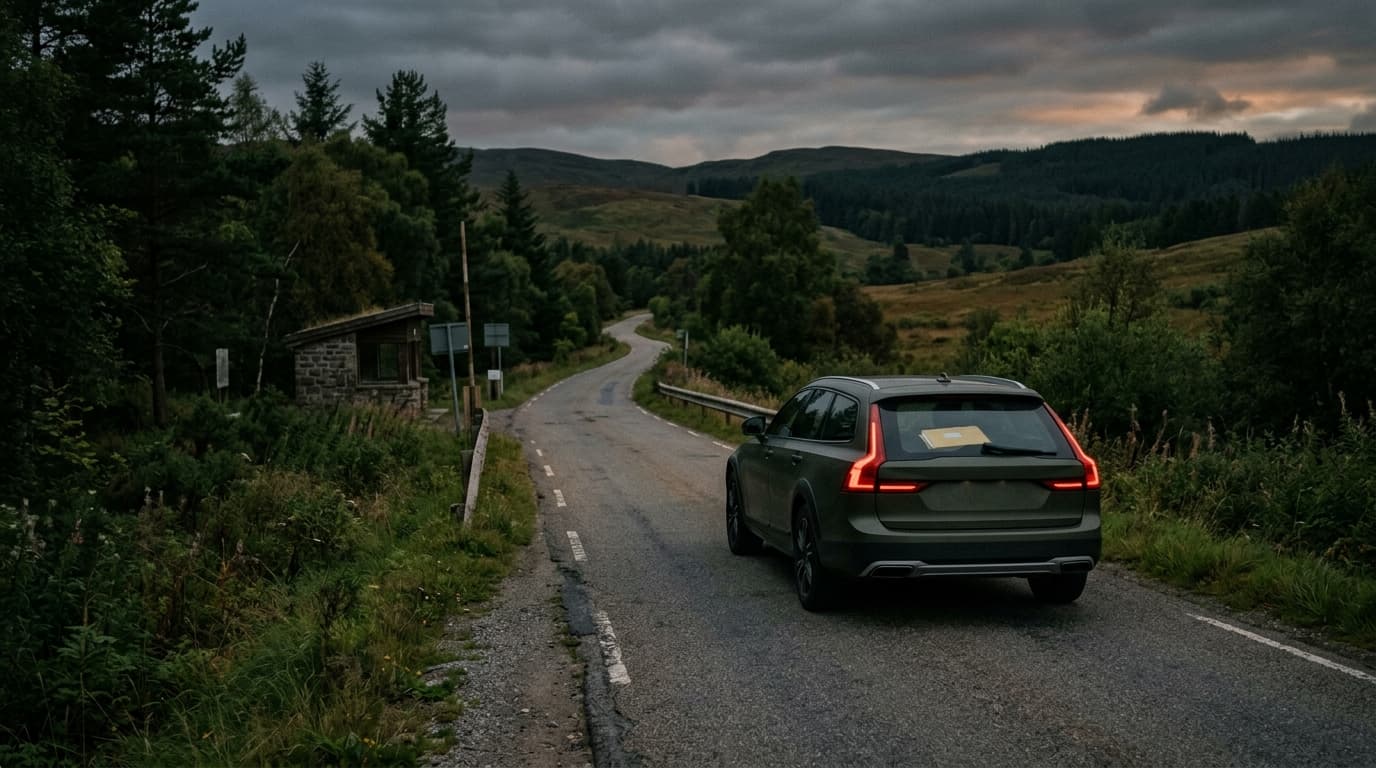
Yes. A Belgian resident employed by a Luxembourg company may drive the company car registered in the Grand Duchy on Belgian roads, without paying either the Belgian registration tax or the annual road tax. The condition sits in the glovebox: a copy of the employment contract and a statement of provision signed by the employer. Without those two sheets, the bill starts at 100 €.
It can end far higher.
Can a Belgian resident drive with a Luxembourg plate?
The starting rule is a ban. Article 3 of the royal decree of 20 July 2001 requires anyone who lives in Belgium to register there the vehicles they put on the road, even if they already carry a foreign plate. The federal police restate it in one sentence on their information page.
The company car of a foreign employer is one of the exceptions written into that same text. It covers a vehicle provided by an employer or principal established abroad, for professional use and, incidentally, private use. SPW Finances, the Walloon tax authority, draws the tax consequence: these vehicles are exempt from vehicle tax. That means both the TMC (taxe de mise en circulation, a one-off registration tax) and the annual road tax.
Two substantive conditions, according to the same source. The driver is an employee of the foreign company. The driver is paid for that work.
For a company Audi A6 or Mercedes-Benz E-Class, the stake is direct: the registration tax and annual road tax that the same car would owe if registered in Arlon or Namur are not due. Luxembourg itself levies no registration tax, and its annual tax runs to a few hundred euros according to a 2018 reading that I could not update from an official source.
Which documents must stay on board?
Two, and they must be in the car, not in a drawer.
- A copy of the employment contract that binds you to the Luxembourg employer, or of the assignment order.
- A document drawn up by that employer, stating that it makes this specific vehicle available to you.
SPW Finances leaves no room: both documents must be on board the vehicle at the time of the check.
The VAT certificate, which many cross-border workers still keep out of habit, is no longer requested. A royal decree of 18 June 2014 abolished it from 1 October 2014. It replaces neither of the two documents above.
How much does a check without the documents cost?
From 100 € to several thousand, depending on what you produce and how fast. The published scale is Walloon.
| Situation at the check, in Wallonia | Amount claimed |
|---|---|
| Contract and statement on board | 0 € |
| Documents missing, sent within 10 days | Flat charge of 100 € |
| Documents not sent within 10 days | Flat 100 €, registration tax, annual road tax, fine of twice the evaded tax |
| Floor and ceiling of the fine | 100 € minimum, 1,250 € maximum |
Scale read on 9 October 2026 in the SPW Finances FAQ, page modified on 10 September 2026.
The 1,250 € ceiling applies to the fine alone. The evaded taxes come on top, and on a powerful car they weigh more than the fine. Two court cases give the scale. Before the court of first instance in Eupen, two Belgian residents stopped at the wheel of company cars registered in Germany, without the documents on board, were asked on the spot for 5,528.40 € in one case and 8,721.55 € in the other, taxes and fine included.
Both cases went up to the Constitutional Court. In its ruling no. 106/2020 of 9 July 2020, it held that article 11bis, § 4, d), of the Walloon decree of 6 May 1999, which organised that immediate payment on pain of having the vehicle held, breaches the right to property guaranteed by article 16 of the Constitution when applied to Belgian residents who use, for their job, a vehicle provided by a foreign employer. The reason: the person had no way of proving afterwards that they were exempt.
The ruling removes neither the duty to carry the documents nor the amounts in the table. It condemns full payment demanded at the roadside with no possibility of proving one's right later. The current Walloon scale allows 10 days to produce the documents.
Two A4 sheets in the glovebox are worth, depending on the car, between 100 € and 8,700 €.
Wallonia, Brussels, Flanders: is the rule the same?
The duty to register and its exception are federal. The two required documents are therefore identical in Arlon, Brussels and Antwerp, and the Flemish sources I consulted, Touring and KBC Autolease, describe exactly the same pair: copy of the contract, statement from the employer.
The tax, however, is regional, and each Region checks and penalises. Wallonia publishes its scale, the one in the table. As of 9 October 2026 I found no official page from Brussels Fiscality or the Vlaamse Belastingdienst (the Flemish tax service) that puts a figure on a flat charge equivalent to the Walloon 100 €. I therefore publish no amount for those two regions.
Walloon checks are not anecdotal: 325 reports in 2019, for close to 100,000 € in revenue, according to figures carried by Paperjam.
Who else may take the wheel?
The sources do not say the same thing, and the gap matters.
SPW Finances writes that the driver is not necessarily the employee, but must be domiciled at the same address. A partner or child living under your roof fits. KBC Autolease, in its note for fleet managers, takes a narrower reading: household members drive only if the main user is also on board.
My advice as a former fleet manager: apply the stricter of the two versions until your employer's car policy says otherwise in writing. And never lend the car to a friend or relative domiciled elsewhere in Belgium. They have neither contract nor statement to show.
Benefit in kind: how much does the car weigh on the Luxembourg payslip?
The benefit is calculated in Luxembourg, under the Luxembourg rule. It is a monthly percentage of the vehicle's new value, options and VAT included. In Belgium the equivalent is the ATN (avantage de toute nature, the taxable benefit in kind). The Luxembourg rates in force until 31 December 2026, published by Klima-Agence, the Luxembourg public agency:
| Powertrain | Monthly rate | Annual benefit on 60,000 € | On 80,000 € | On 100,000 € |
|---|---|---|---|---|
| Electric, 18 kWh/100 km or less | 0.5% | 3,600 € | 4,800 € | 6,000 € |
| Electric, more than 18 kWh/100 km | 0.6% | 4,320 € | 5,760 € | 7,200 € |
| Petrol, diesel, hybrid, plug-in hybrid | 2% | 14,400 € | 19,200 € | 24,000 € |
My own calculation: new value multiplied by the monthly rate, then by twelve. The three values are working assumptions, not list prices I have recorded.
On an 80,000 € saloon, moving from diesel to an efficient electric car removes 14,400 € a year from the taxable base. No other choice in the order moves the net pay as much. A BMW i5 and a diesel 5 Series configured at the same price do not cost their driver the same, and the gap shows on twelve payslips.
The scale is due to change on 1 January 2027, subject to adoption of the grand-ducal regulation: plug-in hybrids under 50 g of CO₂ per kilometre would drop to 1%, electric cars would stay at 0.5 and 0.6% until the end of 2030, then move to 1 and 1.2% in 2031.
For comparison, the Belgian calculation starts from the list value, the CO₂ and the age of the vehicle. It is broken down in how the company car benefit in kind is calculated.
34 days outside Luxembourg, and Belgium takes back part of the tax
The salary of a Belgian cross-border worker, car included, is taxed in Luxembourg as long as the work is done there. The treaty between the two countries tolerates 34 days a year worked elsewhere, teleworking in Belgium included, since 1 January 2022. The amendment was approved by the Belgian law of 6 February 2023. A day started outside Luxembourg counts as a full day.
Beyond the threshold, pay for days worked outside the Grand Duchy becomes, in principle, taxable in Belgium again, and the car benefit is part of that pay. The exact split depends on your file. Have a tax adviser work it out before you cross the threshold, not after the Belgian assessment notice arrives.
And if you are a manager or director?
This is the poorly covered case. SPW Finances requires a salaried, paid driver. The federal rule also mentions a foreign principal and an assignment order, which leaves a door open to self-employed people working for a Luxembourg client. Back in 2014, when the VAT certificate disappeared, nothing was specified for managers and managing directors with self-employed status, and I have found no official position published since.
Without an employment contract to show, do not assume the exemption. Write to your regional tax office, obtain a dated answer and keep it in the car with the rest.
The director of a Belgian company is not covered by the exception: that car is registered in Belgium and follows the 2026 deductibility rules. Belgian leasing payments are detailed in the real cost of leasing a luxury car in Belgium, and three-year ownership costs, model by model, are in the luxury car ranking.
Sources
- SPW Finances, FAQ on road taxes, page modified on 10 September 2026, consulted on 9 October 2026: exemption for vehicles provided by a foreign employer, salaried and paid driver, two documents on board, flat charge of 100 € if the documents are sent within 10 days, otherwise flat charge, taxes and a fine of twice the evaded tax, from 100 to 1,250 €, driver domiciled at the same address as the employee.
- Constitutional Court, ruling no. 106/2020 of 9 July 2020, docket 7226 and 7257, consulted on 9 October 2026: preliminary questions from the court of first instance in Eupen, breach of article 16 of the Constitution by article 11bis, § 4, d), of the Walloon decree of 6 May 1999, amounts claimed of 5,528.40 € and 8,721.55 €.
- Federal Police, Do you have to register your vehicle in Belgium?, consulted on 9 October 2026: article 3, § 1, of the royal decree of 20 July 2001.
- Klima-Agence, benefits in kind for company vehicles, consulted on 9 October 2026: rates of 0.5%, 0.6% and 2% until 31 December 2026, scale announced from 1 January 2027 subject to adoption of the grand-ducal regulation.
- Touring, general rule on foreign plates, page modified on 25 March 2025, consulted on 9 October 2026: list of exceptions, professional and incidentally private use, copy of the contract or assignment and statement from the employer.
- KBC Autolease, questions on the Luxembourg plate, consulted on 9 October 2026: household members allowed at the wheel if the main user is on board.
- Lesfrontaliers.lu, articles of 17 September 2014 and 10 October 2018, consulted on 9 October 2026: VAT certificate abolished on 1 October 2014 by the royal decree of 18 June 2014, no registration tax in Luxembourg, annual tax of a few hundred euros.
- Paperjam, article on the Constitutional Court ruling, consulted on 9 October 2026: 325 reports drawn up in 2019 by the Walloon Region, close to 100,000 € in revenue.
- Securex, note of 23 September 2021, updated, consulted on 9 October 2026: 34-day tolerance from 1 January 2022, amendment approved by the law of 6 February 2023, any day started counts as a full day.
- Pixie.lu, sheet reviewed on 4 April 2026, consulted on 9 October 2026: calculation base on the new price, options and VAT included.
- No official source consulted on 9 October 2026 publishes a Brussels or Flemish flat charge equivalent to the Walloon 100 €, a position on self-employed directors of a Luxembourg company, or the current Luxembourg annual tax by model. These points are flagged as such in the article.
Comparator
Compare voitures de luxe side by side.
Compare now →
Frequently asked questions
Renaud a passé neuf ans comme gestionnaire de parc chez un loueur longue durée belge, du côté où l'on calcule la valeur résiduelle d'une berline allemande à 48 mois avant même de la commander. Il a quitté le métier en 2020 et écrit depuis sur le haut de gamme, depuis Namur.