A full omnium policy on a premium saloon costs between €800 and €1,800 a year in Belgium. The single most expensive item on that policy appears nowhere in that figure: it is three characters written into the particular conditions, 24M, 36M or 48M. On a car bought at €75,000, moving from agreed value to actual value costs you €15,000 after twenty months. Ten years of premium at the top rate.
How much does it cost to insure a luxury car in Belgium?
Between €800 and €1,800 a year in full omnium, and a premium car sits at the top of that range by construction. No Belgian insurer publishes a rate card: the premium is quoted profile by profile.
Here are the market ranges recorded by CallMePower and updated on 30 July 2026, with the surcharge full cover represents over three years of ownership.
| Cover | Annual premium recorded | Over three years | Surcharge over liability only |
|---|---|---|---|
| Third-party liability | €280 to €550 | €840 to €1,650 | reference |
| Mini-omnium | €410 to €950 | €1,230 to €2,850 | €390 to €1,200 |
| Full omnium | €800 to €1,800 | €2,400 to €5,400 | €1,560 to €3,750 |
The segmentation criteria Belgian insurers apply include brand, model, power output, value and options, alongside driver age, the bonus-malus no-claims rating and place of residence. A Porsche Panamera and a Volkswagen Passat are not rated on the same scale, for an identical driver profile.
Two options are billed separately and rarely appear in headline comparisons. Driver protection runs from €31 a year at Belfius Direct to €73 a year at ING. Legal assistance runs from €34 a year at Belfius Direct to €71 a year at CBC. Together, €65 to €144 a year, or €195 to €432 over three years.
On a premium car, the premium is negotiated in hundreds of euros and the payout is decided in tens of thousands.
What is agreed value and why does it decide €15,000?
Agreed value is the payout figure set in advance, in the contract, before any claim. Actual value is assessed after the event by an expert, based on age, mileage and condition. The first is known on signing day, the second on the day of the accident.
Test Achats describes a two-stage mechanism: for a period defined in the contract you are paid 100 percent of the list price or the invoice price, after which a monthly depreciation rate applies, specific to each insurer. That period is labelled 24M, 36M or 48M according to its length in months. Some contracts grant no full period at all and start depreciating on day one.
The worked example published by Test Achats covers a €20,000 car written off at twenty months: €20,000 paid under 24M agreed value, against €16,000 under actual value. A ratio of 80 percent.
Applied to the upper end of the market, that ratio gives the table below. It is a transposition of the Test Achats ratio, not a model-by-model survey: no public, dated series gives the average actual-value payout rate on the Belgian premium segment, and I do not invent one.
| Purchase price | Payout under 24M agreed value | Payout under actual value at an 80 percent ratio | Your share |
|---|---|---|---|
| €20,000 (Test Achats example) | €20,000 | €16,000 | €4,000 |
| €45,000 | €45,000 | €36,000 | €9,000 |
| €75,000 | €75,000 | €60,000 | €15,000 |
| €120,000 | €120,000 | €96,000 | €24,000 |
The premium surcharge attached to an agreed value clause stays in the hundreds of euros a year. The payout gap runs into tens of thousands. On a recent premium car, that is not much of a trade-off.
Agreed value on list price or on invoice price?
On the list price, where the insurer offers it. Test Achats is explicit: the widest payout comes from an agreed value based on the list price rather than the invoice price.
The distinction weighs heavily at the top of the market, precisely because discounts at order are large there. A saloon listed at €75,000 and invoiced at €66,000 after discount leaves a €9,000 gap between the two bases. Those €9,000 stack onto the €15,000 in the table above if the contract uses the invoice and the claim lands after the full period.
On a company car the question changes owner but not nature: the company receives the payout, and the company has to top up to buy the same vehicle again. The cost of ownership calculation is identical, it simply moves to another accounting line.
How much does replacing a sensor-equipped windscreen with recalibration cost?
Repairing a chip costs €164.17 at Carglass Belgium if you have no glass cover. Carglass presents that repair as six times cheaper than a replacement, which places a replacement around €985 on a mainstream car. No public, dated rate is displayed per premium model, so I publish no price for an S-Class or a Cayenne windscreen.
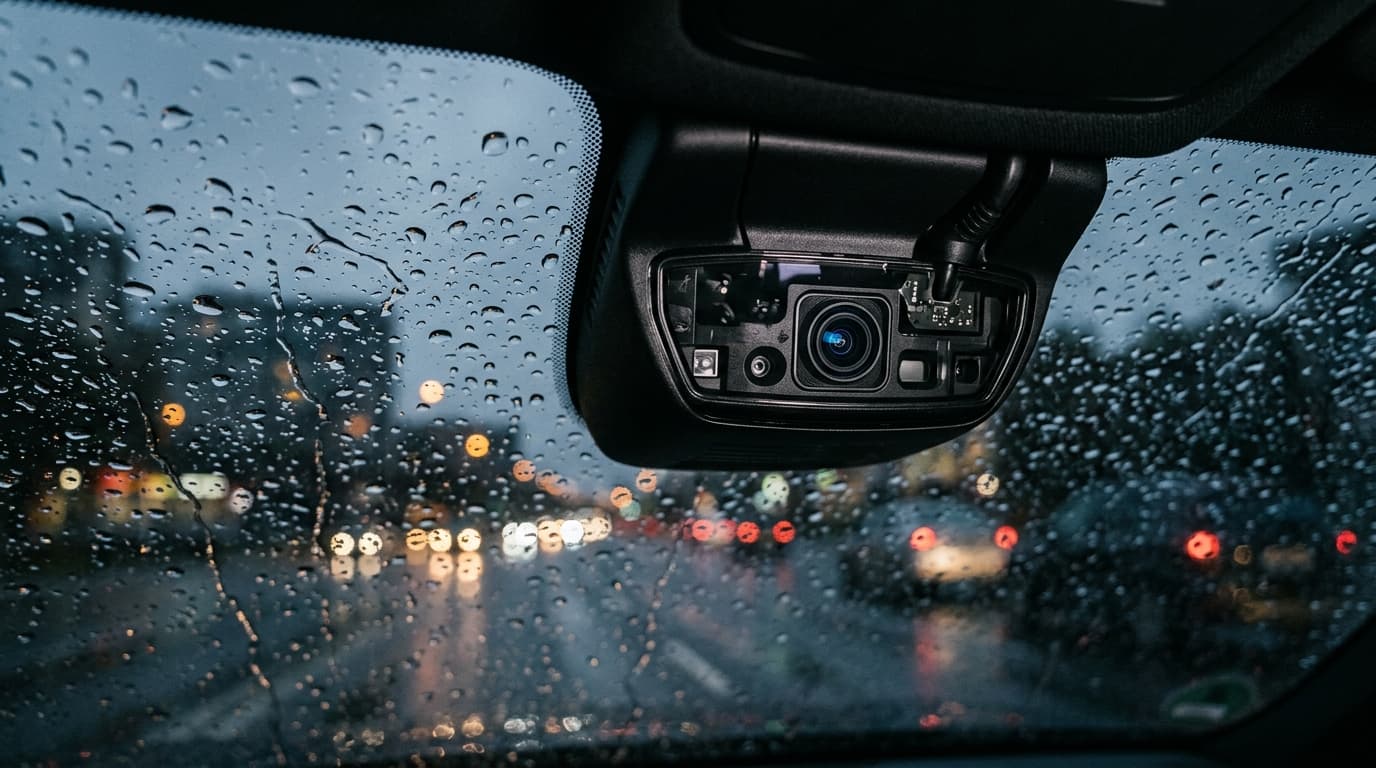
The item that catches owners out is not the glass, it is the recalibration. The camera driving traffic sign recognition, lane keeping and adaptive cruise control sits behind the windscreen. It is disconnected during removal and has to be reset under manufacturer instructions. Carglass Belgium quantifies the job in time: 10 to 40 minutes for the recalibration alone, 2h15 to 2h45 for a replacement including diagnostics and recalibration. A dynamic recalibration also requires driving for fifteen minutes at 50 to 70 km/h on a road with lane markings.
A few millimetres of error in camera positioning is enough to skew its field of view, and therefore the emergency braking trigger. Carglass reports recalibrating 99.4 percent of vehicles immediately after replacement, and refers the remainder to an approved third party. The recalibration certificate issued at the end of the job is the document to keep: it proves compliance if the car is sold or inspected.
Two pieces of good news on this item, rare in the cost of owning a premium car. Glass cover is included in both mini-omnium and full omnium in Belgium. And repairing or replacing a window has no effect on the bonus-malus, which Carglass Belgium confirms on its pricing page.
What anti-theft requirements can a Belgian insurer impose?
Whichever it likes. INCERT, the quality label run by the Belgian Electrotechnical Committee, writes it plainly: each insurance company sets its acceptance policy as it sees fit, based on vehicle value, brand, whether a garage is available and place of residence.
The coding to know before signing comes in four families.
| Code | System | Function |
|---|---|---|
| AL1 / AL2 | Alarm | Siren on perimeter and volumetric detection, no engine cut |
| IA2 | Alarm plus immobiliser | AL2 combined with the factory immobiliser, compulsory in the European Union since 1998 |
| AT1 / AT2 | After-theft slowing | Speed cut to 10 or 30 km/h, restart blocked once stopped |
| TT0 to TT4 | Tracking | Satellite and GSM tracking, automatic alarm and restart blocking depending on level |
TT is now the system most commonly imposed on high-value cars. Its cost is public and comes in three lines. A MetaTrak T342-4G/LTE unit certified TT1 to TT4 is listed at €649.99 at Cartronics on 18 September 2026, excluding fitting. A subscription to the monitoring centre is compulsory to meet the INCERT standard: €252 including VAT a year on the Basic plan, €334 including VAT a year on Premium. Fitting depends on the vehicle and is not listed.
Over three years, unit plus Basic subscription comes to €1,405.99. On Premium, €1,651.99. Excluding fitting in both cases. In other words €469 to €551 a year on top of the premium, the equivalent of a second third-party liability policy.
The trap is not the cost, it is administrative. Only an INCERT-certified fitting station can issue the declaration of conformity, and the insurer may demand it at underwriting or at the moment of the theft. INCERT is explicit about the sanction: failure to meet those requirements can void the cover, meaning that in the event of theft the car is not insured and the owner will not be compensated, even though the premium was paid.
Is the theft risk the same in Wallonia, Brussels and Flanders?
No, and the gap is clear. Federal police recorded 5,782 cars stolen in 2023 nationwide: 3,008 in Wallonia, 1,579 in Flanders and 1,195 in Brussels. Over five years, La Libre counted more than 27,000 vehicles stolen in Belgium in its edition of 28 February 2025. The three most affected municipalities in 2023 were Charleroi with 442 thefts, Liège with 304 and Antwerp with 215.
Those three regional figures cannot be read in absolute terms without relating them to the vehicle parc, and no public series gives the theft rate per thousand registered vehicles by region at that date. So I do not calculate that ratio.
The data does confirm the pricing mechanism. Place of residence is explicitly among the segmentation criteria Belgian insurers use, down to street and neighbourhood. A premium car parked outside in Charleroi, Liège or Antwerp will not be rated like the same car garaged in Marche-en-Famenne, and that same criterion is what triggers the demand for a TT system.
Worth noting on a site that usually deals in regional taxation: unlike the TMC registration tax and the annual road tax, insurance follows no regional scale. Wallonia, Brussels and Flanders apply no different rate here. Only the claims statistics of your postcode move the premium, and they are set by the insurer, not by decree.
What excess should you pick on a premium car?
The highest you can absorb without borrowing, provided you know what a premium bodywork repair actually costs. Third-party liability and mini-omnium policies rarely carry an excess. In full omnium it generally applies to material damage and is chosen at underwriting.
The reasoning inverts at the top of the market. On a hatchback, a high excess pays off quickly because a small knock is repaired for a few hundred euros and settled out of pocket. On a premium car, a bumper packed with radar, cameras and ultrasonic sensors turns the smallest scrape into a four-figure invoice. The excess is then almost always consumed, and it cuts your payout every time.
Three clauses deserve a read before signing, and none of them shows up on a price comparison site: exclusive driving, which voids cover if an undeclared third party takes the wheel, the requirement to park in a locked garage overnight, and the exclusion of damage sustained on a racetrack. That last one catches sports car owners out more often than any other.
The premium is not the most expensive line on this page
Over three years, a full omnium policy costs €2,400 to €5,400, a certified TT system adds €1,406 to €1,652 excluding fitting, and driver protection plus legal assistance another €195 to €432. Total: between €4,001 and €7,484. That is already a cost of ownership item in its own right, on a par with a set of 21-inch tyres or an air suspension overhaul.
But the line that dwarfs all the others stays invisible as long as nothing happens: €15,000 of payout gap on a €75,000 premium car, decided by two words in the particular conditions. Haggling over €200 of premium while ignoring that clause means optimising the wrong number.
The question to put to the broker fits in one sentence: on what basis is agreed value calculated, list price or invoice, and for how many months does it stay full.
Price ranges by model and annual taxes are in the luxury car ranking. The loss of value insurance never covers is set out in premium depreciation. The other maintenance bills that land after the warranty are in air suspension replacement cost. And if the car is financed through renting, insurance is often inside the monthly payment: that is the subject of what leasing a luxury car in Belgium really costs.
Sources
- INCERT, vehicle protection and insurer requirements, consulted 18 September 2026: AL, IA, AT and TT0 to TT4 coding, each insurer free to set its acceptance policy based on vehicle value, brand, availability of a garage and place of residence, compulsory declaration of conformity issued by a certified fitting station, possible voiding of theft cover if requirements are not met, factory immobiliser compulsory in the European Union since 1998.
- Federal police, crime statistics, consulted 18 September 2026: official scope of vehicle theft data in Belgium.
- La Libre, "En cinq ans, plus de 27 000 voitures ont été volées en Belgique", published 28 February 2025, consulted 18 September 2026: 5,782 cars stolen in 2023, of which 3,008 in Wallonia, 1,579 in Flanders and 1,195 in Brussels; Charleroi 442 thefts, Liège 304, Antwerp 215.
- FPS Economy, car insurance, consulted 18 September 2026: Belgian legal framework for motor insurance and compulsory third-party liability.
- Car-Pass, official site of the Belgian mileage certificate, consulted 18 September 2026: logging of workshop visits, document to include in the resale file.
- Test Achats, "Valeur agréée ou réelle : qu'en est-il de l'indemnisation en omnium ?", consulted 18 September 2026: definitions of agreed value and actual value, period of 100 percent payout followed by insurer-specific monthly depreciation, example of a €20,000 car written off at 20 months paid €20,000 under 24M agreed value against €16,000 under actual value, advantage of the list price basis over the invoice basis.
- CallMePower, Garance Urru, "Assurance auto : quel prix pour l'assurance voiture en Belgique ?", updated 30 July 2026, consulted 18 September 2026: ranges of €280 to €550 a year for liability, €410 to €950 for mini-omnium, €800 to €1,800 for full omnium; driver protection from €31 a year at Belfius Direct to €73 at ING; legal assistance from €34 at Belfius Direct to €71 at CBC; segmentation criteria used by Belgian insurers; usual absence of an excess on liability and mini-omnium.
- Carglass Belgium, windscreen repair pricing, consulted 18 September 2026: €164.17 for a chip repair without glass cover, repair presented as six times cheaper than a replacement, glass cover included in mini-omnium and full omnium, direct settlement with every Belgian and Luxembourg insurer, no effect on the bonus-malus.
- Carglass Belgium, compulsory camera recalibration, consulted 18 September 2026: recalibration of 10 to 40 minutes, full appointment of 2h15 to 2h45, dynamic recalibration of fifteen minutes at 50 to 70 km/h, 99.4 percent of vehicles recalibrated immediately, certificate issued after the job.
- Cartronics, MetaTrak T342-4G/LTE certified INCERT TT1 to TT4, price recorded 18 September 2026: €649.99 excluding fitting and subscription, Basic subscription at €252 including VAT a year and Premium at €334, compulsory fitting by an INCERT-certified station.
- No public, dated and verifiable data gives, as of 18 September 2026, the windscreen replacement price by premium model in Belgium, the average actual-value payout rate on that segment, or the theft rate relative to the registered parc by region. The payout figures transposed in this article apply the 80 percent ratio published by Test Achats and are flagged as such.
Comparator
Compare voitures de luxe side by side.
Compare now →
Frequently asked questions
Renaud a passé neuf ans comme gestionnaire de parc chez un loueur longue durée belge, du côté où l'on calcule la valeur résiduelle d'une berline allemande à 48 mois avant même de la commander. Il a quitté le métier en 2020 et écrit depuis sur le haut de gamme, depuis Namur.