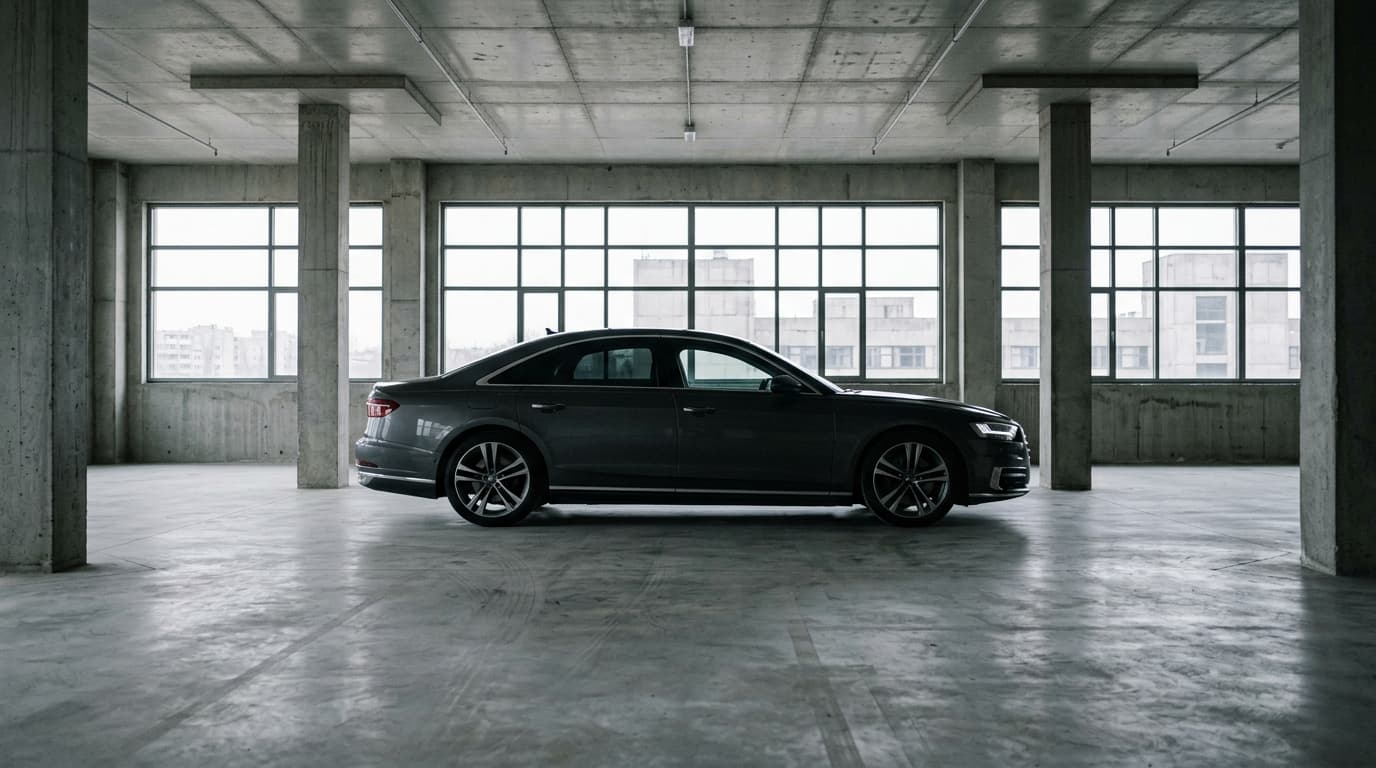
A premium car bought at €75,000 is worth €35,700 three years later, if it follows the depreciation curve Moniteur Automobile published on 16 June 2026. €39,300 gone. €1,092 a month, before a single workshop invoice has landed. And during that time, if the car is registered to a company, the tax authorities still treat it as if it were worth €66,000.
Which luxury car depreciates the least?
The one whose powertrain will still be allowed to drive where it will be sold on in five years. The badge on the grille matters less than the low emission zone calendar.
No public, dated and verifiable series ranks premium models by depreciation on the Belgian market. I do not publish one, and I am wary of those in circulation: they recycle French valuations, with no survey date, no trim, no mileage. What is documented is the mechanism, and Moniteur Automobile lists four of them in its June 2026 valuation guide.
Premium brands — Mercedes-Benz, BMW, Audi, Porsche — take a cushioned price decline compared with mainstream makes, but their loss in euros stays heavier at the start, simply because the starting point is higher. Reputation has shifted from prestige to technical reliability: manufacturers known for the longevity of their hybrid systems, Toyota and Lexus first among them, outperform on the used market. Iconic combustion models from the 2000s and 2010s stop falling after ten to fifteen years, and some climb back. Older diesels, on the other hand, collapse wherever low emission zones shut them out.
Four mechanisms, one question to ask before signing: in five years, who am I selling this to?
How much does a luxury car depreciate per year?
30% in the first year, 20% in the second, 15% in the third, then 12% a year after that. That is the curve Moniteur Automobile records for a combustion car, and it applies to the remaining value, not to the starting value.
| Age | Value remaining | A €75,000 premium car | Cumulative loss |
|---|---|---|---|
| New | 100% | €75,000 | — |
| 1 year | 70% | €52,500 | €22,500 |
| 2 years | 56% | €42,000 | €33,000 |
| 3 years | 47.6% | €35,700 | €39,300 |
| 4 years | 41.9% | €31,416 | €43,584 |
| 5 years | 36.9% | €27,646 | €47,354 |
The €75,000 is a working assumption, not the price of any particular model: no list price appears here without a source, and this one has none. What matters is the shape of the curve.
€39,300 in three years. That is more than the purchase price of a seven-year-old German saloon, and it is the heaviest line in the cost of ownership, far ahead of servicing.
Why does the ATN not fall at the same pace as depreciation?
Because the tax authorities apply their own depreciation, and it has nothing to do with the market. The ATN — the taxable benefit in kind charged to anyone driving a Belgian company car privately — is calculated on the list price reduced by an age coefficient of 6% per started year since first registration, with a legal floor at 70%.
| Year of use | Age coefficient | Tax base | Market value at year end | Gap |
|---|---|---|---|---|
| 1 | 100% | €75,000 | €52,500 | €22,500 |
| 2 | 94% | €70,500 | €42,000 | €28,500 |
| 3 | 88% | €66,000 | €35,700 | €30,300 |
| 4 | 82% | €61,500 | €31,416 | €30,084 |
| 5 | 76% | €57,000 | €27,646 | €29,354 |
| 6 and beyond | 70% | €52,500 | €24,329 | €28,171 |
Take that car as a diesel emitting 140 g of CO2. The CO2 percentage applicable in 2026 is 5.5 + (140 − 58) × 0.1, so 13.7%. The annual ATN starts at €8,807 in year one, drops to €6,693 in year five, and freezes at €6,165 once the 70% floor is reached. Cumulative over five years: €38,751 of taxable benefit, on a car then worth €27,646 on the market.
The ATN is not a tax, it is a notional income added to gross salary. Moniteur Automobile puts the real net impact at 40 to 50% of the amount, which places the bill between €15,500 and €19,400 of tax actually paid over those five years.
The market takes 63% of the value in five years. The tax authorities take 30%. The gap is your bill.
The full calculation, with the reference rates and the €1,690 legal minimum for 2026, is set out in how the company car benefit in kind is calculated.
Diesel, petrol or electric: which depreciates fastest?
On the used market, the electric one. On the tax bill, the diesel, by a wide margin.
For a fully electric vehicle the early loss of value is more linear, but it is highly sensitive to technological obsolescence: a model whose new equivalent has gained range drops away quickly. Mileage takes second place behind battery state of health. An SoH above 90% holds the price; below 80%, a severe discount applies to anticipate cell replacement. Since 2026 the buyer of a used hybrid or electric car is entitled to demand an official battery certificate at the roadworthiness test. That document sets the price more than the odometer does.
On the ATN side the ratio reverses. An electric car is charged the minimum 4% rate, whatever its CO2. On our €75,000 example, in the fourth year of use, that gives €2,109 of annual ATN against €7,222 for the 140 g diesel. €5,113 of difference, every year, on the same list price.
Does the region of registration change the resale value?
Yes, and the gap has widened since 1 July 2026.
In Brussels the LEZ (low emission zone) covers the whole Region, 24 hours a day, enforced by cameras. The tolerance period granted to Euro 5 diesels and Euro 2 petrol cars ended on 30 June 2026: since then those vehicles face a €350 annual fine, or a €35 day pass capped at 24 entries a year. The official calendar bans all diesels in 2030 and all petrol cars in 2035.
In Flanders, Antwerp and Ghent run their own LEZ, but the Flemish government decided in late 2025 not to apply the planned tightening: Euro 5 diesels remain admitted there in 2026.
In Wallonia, no low emission zone is in force.
In practice, a 2019 Euro 6 premium diesel is not worth the same to a Brussels buyer and to a Namur buyer. The first counts the years left until 2030, the second does not. On a used market as narrow as ours, that difference in audience is enough to move a price by several thousand euros — and it explains why the same model sells faster in one province than in another, in a country 300 kilometres long.
Do mileage and the Car-Pass really weigh on the price?
Yes, and it is the part of the file that is easiest to verify in Belgium. The Car-Pass is a legally compulsory mileage certificate for every used car sale, private or trade: it records the mileage logged at each workshop or roadworthiness visit.
The figures from the Car-Pass 2025 annual report give the measure of the risk. 855,169 documents issued over the year. 1,466 odometer fraud cases detected, or one file in 583. Where fraud occurred, the odometer had been wound back by nearly 80,000 km on average — the most extreme case being a 2010 Mercedes-Benz E-Class stripped of 370,000 km.
A complete service book and a consistent Car-Pass do not push a price up. They avoid the suspicion discount, the one a trader applies as a precaution when nothing can be checked.
When should you sell without losing too much?
In a company, at the end of year three. That is where the gap between the tax base and the real value is widest, €30,300 on the example above, and it never closes again afterwards.
In private ownership the trade-off reverses: annual depreciation drops back to 12% from year four, so each additional year costs less than the last. Keeping the car becomes worthwhile exactly when selling it stops being so.
What stays on the invoice
Depreciation never appears on a bank statement, it triggers no reminder, and it is still the line that decides the three-year cost of ownership. It is settled at purchase: powertrain, list price, region of resale. After that, you only absorb it.
List price ranges and annual taxes line by line are in the luxury car ranking. If the car is financed through renting, the residual value is already inside the monthly payment and the calculation changes nature: that is the subject of what leasing a luxury car in Belgium really costs. And if you are buying used rather than new, the traps of the Belgian market are worth reading before you travel to see a car.
Sources
- SPF Finances, company cars and benefits in kind, consulted 23 August 2026: principle of the benefit in kind and the official list price database.
- Royal Decree of 17 December 2025 amending the AR/CIR 92 on benefits in kind arising from the private use of a vehicle made available free of charge, Belgian Official Gazette of 24 December 2025: 2026 reference CO2 emissions set at 58 g/km for diesel and 70 g/km for petrol, LPG and natural gas.
- Car-Pass, 2025 annual report, consulted 23 August 2026: 855,169 documents issued, 1,466 odometer fraud cases, average rollback of nearly 80,000 km, extreme case of a 2010 Mercedes-Benz E-Class wound back by 370,000 km.
- LEZ Brussels, official site of the Brussels low emission zone, consulted 23 August 2026: regional perimeter, day pass and exemptions.
- Moniteur Automobile, Olivier Duquesne, “Connaître le prix d'une voiture décotée”, published 16 June 2026, consulted 23 August 2026: depreciation of 30% in year one, 20% in year two, 15% in year three then 12% a year, SoH thresholds at 90% and 80%, battery certificate at the roadworthiness test, behaviour of premium brands and youngtimers.
- Moniteur Automobile, Olivier Duquesne, “Calculer l'ATN en 2026”, published 31 March 2026, consulted 23 August 2026: age coefficients from 100% to 70%, diesel, petrol and electric formulas, minimum ATN of €1,690 for 2026, net impact estimated at 40 to 50% of the ATN.
- Moniteur Automobile, Olivier Duquesne, “Zone basse émission à Bruxelles”, updated July 2026, consulted 23 August 2026: end of tolerance on 30 June 2026, €350 fine, €35 day pass capped at 24 entries a year, ban on all diesels in 2030 and all petrol cars in 2035.
- Securex, “Le taux d'émission de CO2 de référence pour 2026”, published 19 December 2025, consulted 23 August 2026: diesel and petrol calculation formulas, 4% minimum for electric cars.
- Postponement of the tightening of the Antwerp and Ghent low emission zones decided by the Flemish government in late 2025: Euro 5 diesels remain admitted in 2026. No low emission zone is in force in Wallonia as of 23 August 2026.
Comparator
Compare voitures de luxe side by side.
Compare now →
Frequently asked questions
Renaud a passé neuf ans comme gestionnaire de parc chez un loueur longue durée belge, du côté où l'on calcule la valeur résiduelle d'une berline allemande à 48 mois avant même de la commander. Il a quitté le métier en 2020 et écrit depuis sur le haut de gamme, depuis Namur.