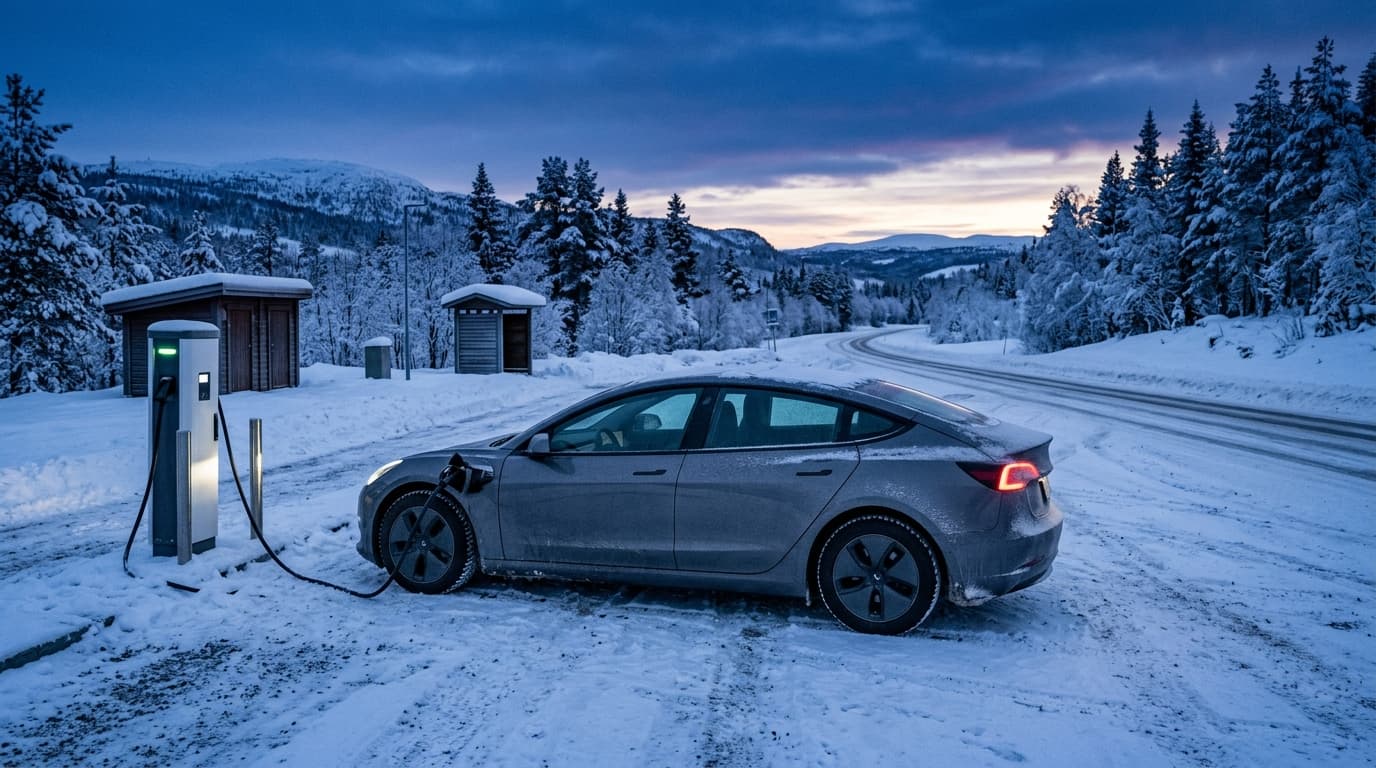
An Audi A6 e-tron rated at 653 km on paper covered 402 km in the Norwegian El Prix 2026 winter test, run down to minus 31 °C. Thirty-eight per cent less. Before transferring that figure to your Namur to Brussels commute, one useful data point: the winter temperature normal at Uccle is 3.6 °C, not minus 31 °C. At that temperature the bill does not move by 38 %, it moves by 1.32 to 1.55 € per 100 km depending on the region where the car is registered.
How much range does a premium electric car lose in winter?
Between 12 and 31 % at 0 °C, 22 % on average. The broadest available measurement comes from the Recurrent 2025-2026 study, built on real driving data from more than 30,000 vehicles: 78 % of range retained at 0 °C, 70 % at minus 6.7 °C, with 88 % for the best model in the panel and 69 % for the last.
The Norwegian El Prix test pushes much further. Motor.no took 25 vehicles along a fixed route until the battery ran flat, with readings down to minus 31 °C, a record for this edition. Here are the premium cars in the field, with their gap to the homologated figure.
| Model | WLTP range | El Prix 2026 measured | Gap |
|---|---|---|---|
| Mercedes-Benz CLA | 709 km | 421 km | -41 % |
| Audi A6 e-tron | 653 km | 402 km | -38 % |
| BMW iX | 641 km | 388 km | -39 % |
| Volvo ES90 | 624 km | 373 km | -40 % |
| Volvo EX90 | 611 km | 339 km | -45 % |
| Tesla Model Y | 600 km | 359 km | -40 % |
Not one of the 25 cars reached its claimed figure. The smallest gap in the field, 29 %, went to two entry-level models, not to the large saloons.
Why does the WLTP figure never show up on the trip computer?
Because WLTP is not a journey forecast, it is a type-approval procedure. It runs in a laboratory at 23 °C, with heating and air conditioning switched off, at an average speed of 46.5 km/h. None of those three conditions describes a Tuesday in January on the E411 motorway.
The gap is therefore not a fault in the car, it is a difference of definition. Geotab, which analysed more than five million trips, places peak efficiency at 21.5 °C and finds that nearly all of the homologated range remains available between 10 and 30 °C. Below 10 °C, the curve falls away.
The Audi A6 Sportback e-tron performance is rated at 14.4 to 16.6 kWh/100 km depending on configuration, with a 94.9 kWh net battery. Those two numbers are enough to rebuild the real bill.
| Condition | Range | Reconstructed consumption |
|---|---|---|
| WLTP type approval at 23 °C | 653 km | 14.5 kWh/100 km |
| 0 °C, Recurrent ratio of 78 % | 509 km | 18.6 kWh/100 km |
| Minus 31 °C, El Prix measurement | 402 km | 23.6 kWh/100 km |
This is my own calculation, obtained by dividing the 94.9 kWh net capacity by each of the three ranges. The middle line is the one that concerns you in Belgium. The last one describes Scandinavia.
What does 100 km of winter driving cost in Flanders, Brussels and Wallonia?
From 5.99 to 7.04 € at home, depending on where you sleep. Every quarter, the Belgian energy regulator CREG publishes the average domestic electricity price per region, the figure that caps tax-free reimbursement of home charging for a company car. For Q3 2026: 32.22 cents/kWh in Flanders, 37.19 in Brussels, 37.83 in Wallonia.
| Condition | Flanders | Brussels | Wallonia |
|---|---|---|---|
| WLTP, 14.5 kWh/100 km | 4.67 € | 5.39 € | 5.49 € |
| Belgian winter at 0 °C, 18.6 kWh | 5.99 € | 6.92 € | 7.04 € |
| Extreme cold at minus 31 °C, 23.6 kWh | 7.60 € | 8.78 € | 8.93 € |
| Winter premium per 100 km | +1.32 € | +1.52 € | +1.55 € |
Over a 4,000 km winter, that premium comes to 52.80 € in Flanders and 62.00 € in Wallonia. Less than one tank of petrol in an equivalent combustion saloon.
The gap that really costs is not seasonal, it is regional and permanent. Between the Flemish and the Walloon tariff, 5.61 cents separate the same kilowatt-hour. Over 20,000 km a year at 16 kWh/100 km, that is a 179.52 € annual gap between two drivers of the same car, one living in Ghent, the other in Namur. That difference lands every month, not just in January.
Winter costs you 62 € over a quarter. Your postcode costs you 180 € a year.
What does rapid charging on a Belgian motorway cost in the cold?
Three times the domestic tariff, and that is where winter bites. Moniteur Automobile reports for 2026 a range of 0.40 to 0.50 €/kWh for rapid charging with a subscription or at the cheapest operators, and 0.70 to 0.89 €/kWh at motorway base rates. The country has passed 100,000 public charge points, of which more than 6,000 are ultra-rapid units above 100 kW.
| Tariff per kWh | 100 km at WLTP | 100 km at 0 °C | 100 km at minus 31 °C |
|---|---|---|---|
| Home in Flanders, 0.3222 € | 4.67 € | 5.99 € | 7.60 € |
| Rapid with subscription, 0.45 € | 6.53 € | 8.37 € | 10.62 € |
| Motorway base rate, 0.79 € | 11.46 € | 14.69 € | 18.64 € |
| Motorway top of range, 0.89 € | 12.90 € | 16.55 € | 21.00 € |
Between the cheapest and the most expensive cell in that table sits a factor of 4.5. Temperature explains only part of it: the rest comes down to where you plug the cable in. A full 94.9 kWh charge costs 30.58 € on a Flemish domestic socket and 84.46 € on a motorway charger at full rate, a 53.88 € gap for the same energy.
Does cabin heating explain the whole winter overconsumption?
No, it is the most visible part. An electric motor gives off almost no waste heat, unlike a combustion engine that warms the cabin for free with its own losses. In an EV, every degree inside the cabin comes out of the battery.
Four less obvious items add to it: thermal preconditioning of the battery before a rapid charge, the rolling resistance of cold tyres, the higher density of cold air, and the degraded chemical efficiency of the cells at low temperature. An EV consumes more in the cold even with the heating off, which settles the argument.
Does a heat pump change anything on the bill?
Roughly 10 % more range at 0 °C against a resistive heater, according to Recurrent. On our reference saloon, that brings winter consumption down from 18.6 to 16.7 kWh/100 km, or 0.70 € less per 100 km at the Walloon tariff.
Over a 4,000 km winter, 28.00 € saved. No manufacturer publishes a separate, dated and verifiable option price for this single piece of equipment on the Belgian market, so I do not calculate a payback period and I do not invent one for you. Simply check whether the heat pump is standard on the trim you are considering, because on premium models it often is, and the sales argument gets made anyway.
Does winter change your benefit in kind or your deductibility?
No, and that is the only good news on this page. The benefit in kind on a company car, called ATN in Belgium, is calculated on catalogue value, vehicle age and homologated CO2 emissions. A real consumption of 23 kWh/100 km in January does not change it by a cent. Deductibility follows the same logic: it depends on the powertrain and the order date, not on the thermometer.
Winter therefore shifts one line only: energy. The remaining question is who pays for it. If the company reimburses home charging at the CREG tariff for your region, the winter premium is absorbed by the employer, within the regional cap. If your car policy applies the lowest of the three regional tariffs, which an employer is entitled to do provided it is written down, a Walloon driver carries 5.61 cents/kWh out of pocket, winter included.
1.55 € per 100 km, and a postcode worth 180 € a year
The spectacular number in this article, 402 km instead of 653, describes a Norwegian night at minus 31 °C. The useful number is 509 km and 7.04 € per 100 km, under a Belgian winter averaging 3.6 °C. The gap between those two readings amounts to 250 km of range wrongly written off.
Three conclusions before you order. Read the homologated consumption rather than the advertised range, because consumption is what converts into euros. Check whether a heat pump is standard. And know that on a long winter journey, your bill depends less on the car than on the charging network you stop at.
Models and their homologated ranges are in the luxury electric car ranking, and the wider segment in the luxury car ranking. The matching ATN and deductibility calculation is set out in the best electric luxury cars for company directors and in company car: petrol, diesel or electric. As for depreciation, far heavier than energy over three years, it is covered in luxury car depreciation.
Sources
- CREG, tariff for reimbursing home charging of company cars, accessed 18 September 2026: official framework for the quarterly regional cap, and for the tax and social security exemption within the published amount.
- FLEET, Gregory Livis, "Company cars: the CREG tariffs for reimbursing electric charging in Q3 2026", published 8 May 2026, accessed 18 September 2026: 32.22 cents/kWh in Flanders, 37.19 in Brussels, 37.83 in Wallonia for July to September 2026; quarterly history since Q1 2025; the employer's option to apply the lowest of the three regional tariffs provided it is set out in the car policy.
- Moniteur Automobile, Olivier Duquesne, "The main rapid-charging networks in Belgium", published 12 April 2026, updated July 2026, accessed 18 September 2026: 0.40 to 0.50 €/kWh at the low end of rapid charging and 0.70 to 0.89 €/kWh at motorway base rates; more than 100,000 public charge points in Belgium including more than 6,000 above 100 kW; billing by the minute once the battery is full.
- Royal Meteorological Institute of Belgium, climate statistics for the municipality of Uccle, accessed 18 September 2026: winter temperature normal of 3.6 °C at Uccle.
- Audi Media Center, Audi A6 Sportback e-tron technical data, accessed 18 September 2026: homologated consumption of 14.4 to 16.6 kWh/100 km depending on configuration.
- EV Database, Audi A6 Sportback e-tron performance specification, accessed 18 September 2026: 100.0 kWh gross and 94.9 kWh net battery capacity.
- Motor.no, El Prix winter 2026 test, reported by InsideEVs, "25 EVs Were Range-Tested In Extreme Cold", accessed 18 September 2026: 25 vehicles, temperatures down to minus 31 °C, no model reaching its homologated figure; Mercedes-Benz CLA 709 km against 421, Audi A6 e-tron 653 against 402, BMW iX 641 against 388, Volvo ES90 624 against 373, Volvo EX90 611 against 339, Tesla Model Y 600 against 359; smallest gap in the field at 29 %.
- Recurrent, 2025-2026 winter study covering more than 30,000 vehicles, accessed 18 September 2026: 78 % of range retained at 0 °C and 70 % at minus 6.7 °C, 88 % for the best model and 69 % for the last, roughly 10 % gained at 0 °C by a heat pump over a resistive heater.
- Geotab, analysis of more than five million trips, accessed 18 September 2026: homologated range almost entirely retained between 10 and 30 °C, peak efficiency at 21.5 °C.
- The kWh/100 km figures in the three lines of the reconstruction table are my own calculation: 94.9 kWh net capacity divided by the range of each scenario. No public, dated and verifiable study measures premium EV range loss under a Belgian climate: the ratios applied come from American and Norwegian panels and are flagged as such. No public, dated option price exists for the heat pump alone on the Belgian market, so no payback period is calculated here.
Électrique premium comparator
Compare all électrique premium side by side.
Compare now →
Frequently asked questions
Renaud a passé neuf ans comme gestionnaire de parc chez un loueur longue durée belge, du côté où l'on calcule la valeur résiduelle d'une berline allemande à 48 mois avant même de la commander. Il a quitté le métier en 2020 et écrit depuis sur le haut de gamme, depuis Namur.